Tuition & Financial Aid
For more information on new federal legislation and loan changes, please visit the University's Financial Aid Updates & Recent Legislation webpage.
Financial Aid for JD students
A degree from Duke Law is an investment with many benefits - career options, earning potential, leadership development, and the chance to join an active and extensive alumni network. However, we realize that many applicants cannot fund a legal education on their own. For that reason, Duke Law devotes significant resources to scholarship funding in order to support applicants who demonstrate exceptional merit as well as financial need. These awards help to offset the cost of your legal education while making a wide array of legal jobs possible.
In conjunction with scholarships, federal loans, and our Loan Repayment Program (LRAP), the Research Triangle's low cost of living make it possible to minimize the cost of your legal education. This is important to consider when comparing law schools. While others may also offer aid, few can offer the combination of scholarship funding and low costs available at Duke Law.
Scholarships
Duke Law awards three-year scholarships to entering law students. All scholarships are based on either merit (defined broadly to include academic excellence as well as a range of other personal accomplishments and experiences) or a combination of merit and financial need. Scholarship awards are guaranteed for three years of law school, assuming students remain in good academic standing. These scholarships are funded from an extensive number of donor-funded, distinguished named scholarships, some of which are highlighted below, as well as the General Scholarship Fund. The Mordecai Scholarship program provides between three and six full-tuition, merit-based scholarships annually. Neither the Mordecai Scholarship or named scholarships require a separate application - all admitted students are considered for them during the scholarship review process.
Student Perspectives

Another constant in my law school experience – the one that largely makes the rest of them possible – has been the continued financial support of my Davies Scholarship, which has singularly allowed me to focus on making the most of every opportunity Duke Law has provided for me without the additional stress of worrying too much about how I would manage to pay for it.

Initiated in 1997, the Mordecai Scholars program is a family of scholarships named for Samuel Fox Mordecai, the founding dean of the Law School. Mordecai Scholars receive merit scholarships that cover the full cost of tuition.
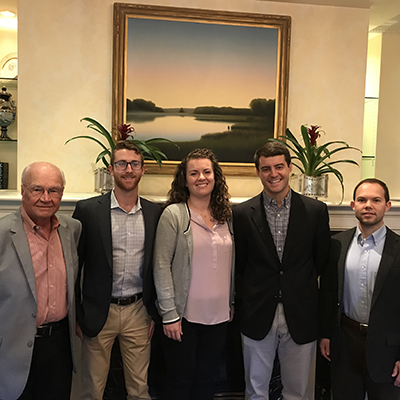
The Robert N. Davies Scholarship was established in 2007 by Robert Davies '61, to provide financial assistance to students with demonstrated financial need who have achieved a high level of academic success.

The Kirkland L. Hicks Scholarship was established in 2015 by Kirkland L. Hicks '97. Mr. Hicks most recently worked as the executive vice president and general counsel for the Lincoln Financial Group.
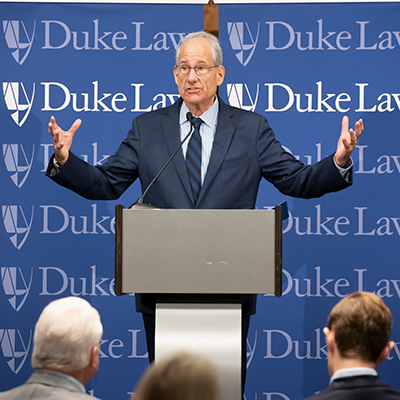
The David W. Ichel Duke Leadership Law Scholarship was established in 2016 by David Ichel '78 T '75 and his wife, Jan, to provide support for an outstanding Duke University undergraduate who is continuing their education at Duke Law School.
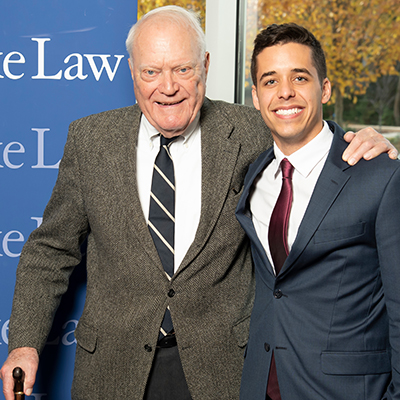
The Judge Gerald B. Tjoflat Scholarship was established in honor of Gerald Tjoflat '57 in 2006 by Duke Law graduates, as well as other supporters, including many of Judge Tjoflat's former law clerks. Judge Tjoflat is the longest-serving federal appeals-court judge on the bench.

The David A. and Katherine S. Payne Law Scholarship was established in 2018 by David Anderson Payne '88, T '84, and Katherine S. Payne '87, T '83, to provide scholarship support for Duke Law students.
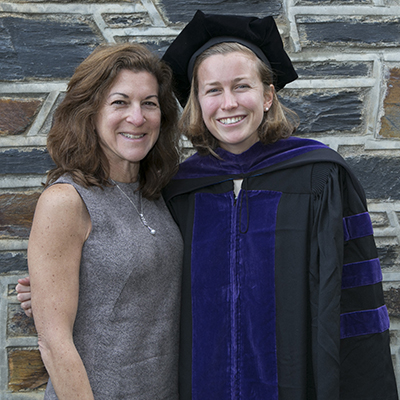
This scholarship was created by Caroline Bergman Gottschalk '90 to provide financial assistance for a deserving law student. Ms. Gottschalk is a partner at Simpson Thacher & Bartlett in New York.

The Jerome M. Culp, Jr. Scholarship was established in 2004 in memory of Professor Culp who was a distinguished member of the Duke Law faculty from 1985-2004. He impacted the lives of countless students and colleagues and was internationally known for his work on race and the law.

The Candace M. Carroll and Leonard B. Simon Scholarship was established in 1998 by Candace M. Carroll '74 and Leonard B. Simon '73. Mr. Simon is a member of the Law School’s Board of Visitors.
Loans
Educational loans are offered by both the federal government and private lenders. Applicants who have good credit and are U.S. citizens or permanent residents will be able to fully finance the cost of a legal education. Students who borrow through the federal program can make use of programs such as the Income-Driven Repayment Plans, the federal Public Service Loan Forgiveness (PSLF) Program, and Duke’s Loan Repayment Assistance Program (LRAP). Additional information about loan options can be found in the Financial Aid Handbook.
Loan Repayment Assistance Program
Duke Law has a long-standing tradition of supporting students and graduates who commit to public service careers. The Loan Repayment Assistance Program (LRAP) program greatly reduces the degree to which financing the cost of a legal education limits career options and opens the door to public service careers by providing a path for total loan forgiveness.
Financial Aid for LLM Students
LLM for International Law Graduates
Duke Law has limited financial assistance to offer international students. A small amount of scholarship assistance based on merit is awarded to outstanding applicants. For information on financial assistance for international students, visit the International Studies website.
Law and Entrepreneurship LLM Students
Most students who are eligible for federal student loans will be able to borrow an amount sufficient to cover the cost of attendance, including tuition and living expenses, but the type of federal loan available will depend on the borrowing history of the applicant. Limited scholarship assistance may be available to some applicants; students will be invited to complete a scholarship application upon admission to the program. Contact the Office of Financial Aid for more information.